
Mini Jesus, Major Love
- Michael Jones
- Nov 8
- 4 min read

I didn’t speak first. I didn’t even try. I just placed a palm-sized Jesus on ordinary surfaces, café tables, a supermarket shelf, a desk in the staff room, on the water dispenser, and then I watched the room do the talking.
The first time, a waitress clocked the little figure on the cafe bench I left it on. She looked around, picked it up, but didn't say anything. She carried the tray back to the counter, lifted Mini Jesus for her co-workers to see, and someone behind the espresso machine shrugged: “Well, it is Sunday.” It wasn't thrown away but rather put on the shelf behind the counter for all to see. The line landed like a half-joke, half-confession, as if the day itself still carries a memory the week hasn’t entirely managed to erase. Nobody sermonised. Nobody rolled their eyes. They just… noticed.
That became the pattern. In the staff kitchen, someone pointed and picked up the figurine from the top of the microwave, “Is that…?, Two colleagues leaned in, smiling the way people do at baby photos. On aisle seven, Mini Jesus sat between in front of Milo cereal while a mum reached for cereal and whispered to her daughter, “Look, it’s little Jesus,” the way you’d whisper in a museum at a painting you didn’t expect to see. There was no negative comment made; it was given to the little girl who put it in her pocket.
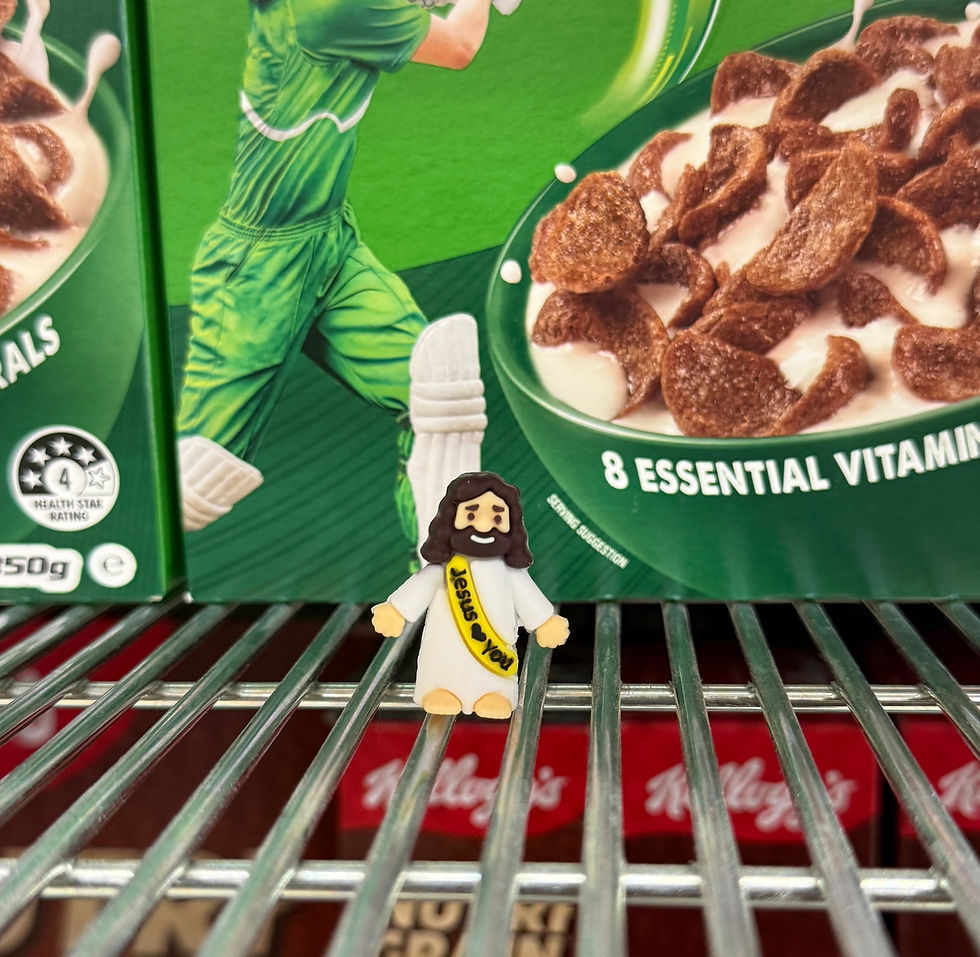
What I had hoped for by doing all this wasn't the object itself; it was the social choreography that happened around it. A room will always organise itself around what it can’t ignore. Place a phone on a table, and the conversation tends to lean toward notifications. Put a symbol of Presence on a table, and conversation leans, ever so slightly, toward presence. The icon didn’t dominate the space; it tilted it. It changed the centre of gravity from “tasks” to “someone,” without a word from me. There’s a design truth here: form sets behaviour. Small forms set gentle behaviour. A palm-sized Jesus doesn’t bark orders or demand allegiance. It whispers in a room that’s already a little tired of shouting. That’s why the reactions felt warm rather than wary: a chuckle, a softening, a nudge of curiosity. It’s also why the comment, “Well, it is Sunday”, felt bigger than banter. It was cultural liturgy breaking the surface. Even in a secular calendar, Sunday still remembers someone.
There’s also a storytelling truth here: people were already carrying a story. The mini icon just gave them a safe excuse to let a sentence of it out. A barista remembered a grandmother’s habit. A shopper offered a reverent whisper to a child, like passing on a family heirloom. A tradie brushed past comfort without needing a meeting about it. The reactions were the content. I was just the witness.
Underneath all of this sits a theology the Church has trusted since Bethlehem: small is God’s favourite size for big things. A manger. A mustard seed. A wafer. “The Word became flesh and dwelt among us” (John 1:14) doesn’t mean “the Word once did a cameo.” It means God is comfortable in rooms like these, cafés, corridors, checkout lines, and comfortable with the human reactions that ripple when He’s near: laughter, relief, a throwaway comment that isn’t throwaway at all. I think that’s why none of this felt kitsch up close. The icon wasn’t demanding belief. It was making room. It gave people permission to be gently serious for half a second, the way you might when music you love drifts through a shop and you pause, mid-task, to let a bar of it land. Christian artist, Tauren Wells, talks about hope having a sound; this had a sound too: plates, steam wands, aisle scanners, and beneath them, a note of recognition. “Oh. Right. Him.”.
A café freezer, a supermarket shelf, and a break-room water dispenser, notice how ordinary everything is. That’s the point. Holiness doesn’t bruise the room to make an entrance. It borrows the furniture. A symbol on a shelf doesn’t turn a supermarket into a chapel, but it does remind the aisle what every chapel exists to remind: God is not far. “You are the light of the world… it gives light to all in the house” (Matthew 5:14-15). “All” includes laminate. I didn’t engage ever. I let the room talk to itself. I listened for the temperature shift when attention moved from things to a Person. And I learned something practising this quiet evangelisation: not every seed needs a speech. Some need a visible centre, something small enough to touch and humble enough to be ignored, so that the human heart can decide, freely, what to do next.
Try this for one week: wherever you already find yourself (café, staffroom, checkout), become a noticer of reactions. When anything even faintly Jesus-adjacent crosses the room, a cross on a necklace, a grace before eating, a hymn leaking from someone’s earbuds, don’t interrupt. Just register what happens around it. Later that day, write down one sentence you witnessed that carried more weight than it knew. Then pray that sentence back to God by name:“Lord, you heard ‘well it is Sunday.’ Let that memory become invitation.”
If you’re carrying something heavy, add your sentence to the pile. God is fluent in throwaway lines. He knows how to turn “it is Sunday” into “I'm here for you”, and how to meet people exactly where they noticed Him, even if they never meant to.


Comments